
WhICH Gas Do I Need?
A simple way to choose
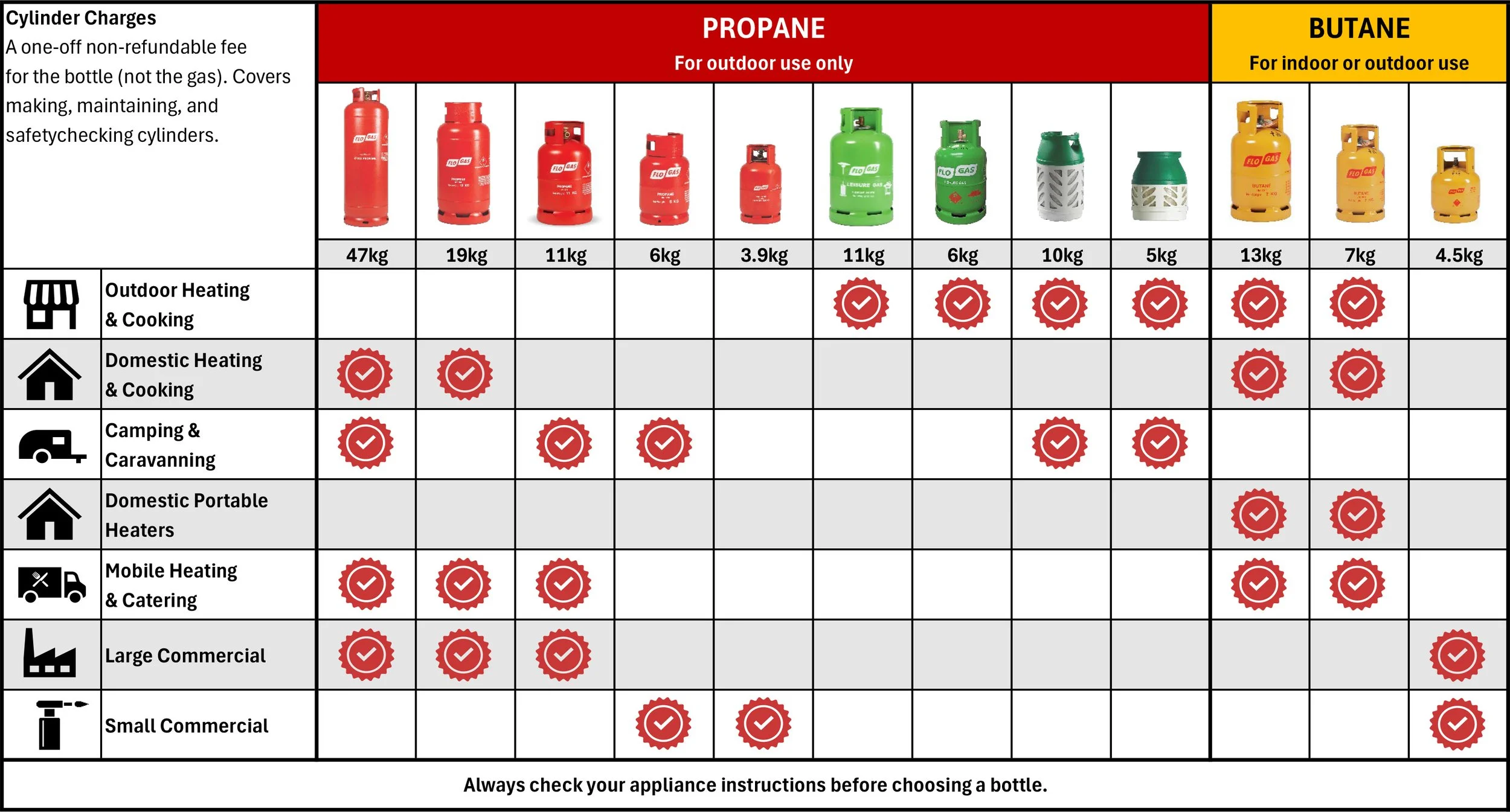
As a general guide:
PROPANE is often used for outdoor cooking and heating.
BUTANE is commonly used for portable heaters and some indoor or leisure appliances.
Leisure setups such as camping and caravanning may use either, depending on the appliance.
Larger heating or commercial needs may require a bigger cylinder.
If you are still unsure, contact our team and we will be happy to guide you to the right product, and we can place the order for you.
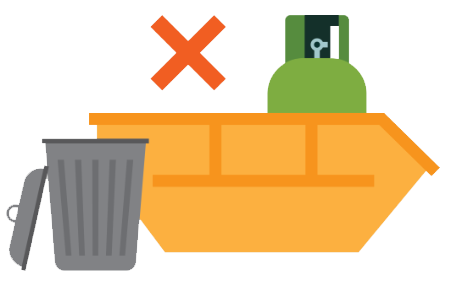
Do not skip or bin your gas bottles
Please return to us or call us and we’ll collect it for free.
REMEMBER…
Cylinder SELECTION
Which Type Do I Choose?
EXCHANGE BOTTLE: Choose this option if you have an empty cylinder, and wish to exchange it for a full cylinder.
NEW BOTTLE: Choose this option if you do not have a cylinder to exchange. A ‘cylinder charge’ has been applied to the price. Please read below to explain more about the agreement & charges.
CYLInDER CHARGES
With the ‘NEW BOTTLE’ option, the charge is per cylinder and is non-refundable. The cylinder will remain our property and it’s provided to you only for the purposes of using the gas supplied. When the cylinder is empty, you can simply exchange it for a pre-filled cylinder or return the empty cylinder to us. There is no charge when swapping a cylinder within the same category.
Terms & Conditions - LPG Cylinder Supply
Ford LPG is a trading name of Ford Fuels Ltd.
All cylinders remain the property of Flogas Ltd at all times. Customers are granted the use of the cylinders solely for the purposes of consuming the LPG contained within. At no point will property of the cylinder pass to the customer.
Ford LPG are only permitted to handle or remove LPG cylinders that are owned by Flogas Ltd or any subsidiary company of Flogas Ltd.
The Cylinder Refill Agreement charge is a non-refundable charge covering the provision of the LPG cylinder for the express use of consuming the LPG within.
Empty cylinders may be exchanged for a full cylinder within the same category. Further details on cylinder exchanges can be found in our website FAQs below.
The customer is responsible for ensuring safe access for cylinder delivery, collections, and inspections.
All empty cylinders should be returned promptly after use and in good condition. Failure to return cylinders may incur additional charges.
Ford Fuels is not liable for any damage, injury, or loss resulting from improper use, handling, or storage of LPG cylinders.
In the event that there is no empty cylinder to return upon our arrival, Ford LPG reserve the right to charge a cylinder refill agreement charge at the prevailing rate.
In the event of a customer not requiring the full order of LPG cylinders on our arrival, Ford LPG reserves the right to charge an aborted delivery charge of £15 per cylinder. This includes non-delivery due to no access being available or access being deemed unsafe.
When a customer signs up to our Cylinder Check system, we will monitor the usage of the customers cylinders and will automatically replace any cylinders that are required. The customer is also required to monitor usage in case their usage changes dramatically and should advise Ford LPG if cylinders need replacing outside of the normal replacement schedule.
FAQs
-
Liquefied Petroleum Gas (LPG) refers to two types of natural gas – Propane and Butane. Both Propane and Butane are produced as a bi-product of both gas & oil extraction (66%) and refining crude oil (34%).
LPG exists as a gas under normal atmospheric pressure and becomes a liquid at very low temperatures and under pressure. This means it can be stored and transported as a liquid in pressurised steel tanks and cylinders.
When the pressure is released, the liquid ‘boils’ to form a vapour and increases its volume some 250 times. The vapour produces a very hot flame ideal for heating, cooking and running vehicles.
-
Butane: Sold in ‘blue or yellow bottles’, butane freezes at 0 degrees Celsius and, as such, is not suitable for outdoor use in winter, or in cold climates.
We sell it in 13kg, 7kg and 4.5kg cylinders.
In temperate climates like the UK it is often used for cabinet heaters, gas BBQs, Camping Gas, and cigarette lighters.
Propane: Sold in red bottles, green ‘Leisure Gas’ cylinders, or in Gaslight bottles – propane freezes at minus 42 degrees Celsius and is suitable for outside use in all but very extreme climates.
We sell it in 47kg, 19kg, 18kg, 11kg, 6kg and 3.9kg cylinders.
Common uses range from central heating for houses and offices to factories and poultry sheds, driving a variety of machines from incinerators to FLTs and cars, and for a number of industrial and commercial heating processes from grain drying to cooking and baking in very large quantities.
-
The green ‘Leisure Gas’ cylinders contain propane and are perfect for outside uses such as BBQ’s, pizza ovens, and patio heaters.
Leisure gas cylinders have 27mm clip on regulator making it easy to use with no spanners required.
-
Gaslight cylinders contain propane and perfect for outside uses such as BBQ’s, pizza ovens, and patio heaters. Weighing in at 15kg, Gaslights are considerable lighter than typical gas cylinders making them easy to handle.
Gaslight cylinders have 27mm clip on regulator making it easy to use with no spanners required.
-
We supply LPG in the following cylinder sizes:
Propane: 47kg, 19kg, 18kg (FLT), 11kg, 6kg & 3.9kg
Butane: 13kg, 7kg, 4.5kg
Leisure Gas: 11kg & 6kg
Gaslight: 10kg & 5kg
-
VAT on LPG gas is charged at the reduced rate of 5% for domestic and small commercial uses.
Cylinder agreements and delivery charges are charged at the full rate of VAT at 20%.
-
We deliver throughout Dorset and South Somerset.
BA8, BA9. BA20, BA21, BA22, BH16, BH19, BH20, DT1, DT2, DT3, DT4, DT5, DT6, DT8, DT9, DT10, DT11, SP2, SP3, SP5, SP6, SP7, SP8, TA10, TA11, TA12, TA13, TA14, TA15, TA16, TA17, TA18, TA20
-
When you place your order you will be asked for your mobile number which will be used to text you details of when your delivery has been scheduled.
-
Yes – our drivers are trained to remove your empty cylinder and to connect your newly delivered full cylinder.
-
Once you have placed your order it will be process by our office and passed to the transport team. Transport will then organise a delivery when we are next in your area – commonly within 3 working days. If you are urgent please let one of our team know and we will expedite your delivery and can usually delivery the next business day.
All deliveries are made on an open backed transit van size vehicle and our driver will need clear access to deliver your cylinder.
-
Yes you can collect from our depot at Gibbs Marsh Trading Estate, Stalbridge, Sturminster Newton, DT10 2RU – out What3Words address is bond.warrior.mistaking.
-
You can order LPG cylinders with us either by calling 01963 853190 or by placing an order online.
-
Once your order has been placed we will deliver your gas cylinder within 3 working days.
-
Delivery is free for orders of over £75.00.
Smaller orders will be subject to a £7.50 delivery fee.
-
If you suspect a gas leak you should turn off the gas bottle and move to a safe place if you can.
You should then:
Extinguish all possible sources of ignition within 7.5m of the leak. If the leak is indoors, extinguish any sources of ignition and gas appliances, where safe to do so.
Don’t operate and electrical equipment – including switches.
Don’t smoke or vape.
Call us on 01963 853190 and our team will be happy to help you.
If the suspected leak is indoors increase ventilation by opening doors and windows.
-
A variety of pressure regulators or hose assemblies can be connected to the cylinder valve, but the regulator connection is the same – UK POL 5/8” LH male. First, ensure the POL thread is clean and undamaged and then offer up to the cylinder valve.
The connection is left hand to tighten, right hand to disconnect. Care should be taken to select the correct direction! A spanner will be required to ensure gas soundness is achieved by the final firm ‘nip’ to tighten onto the valve thread. It is advisable to perform a leak test with a simple soap solution. If bubbles form around the valve, consider tightening the nut further but not with excessive force.
If bubbles continue to form, it would be advisable to replace the regulator as permanent damage will have been caused to the POL. Once the regulator has been connected the cylinder valve can be turned on.
-
All Flogas butane cylinders have either a 20mm or 21mm valve, so they need be fitted with the correct clip-on regulator. You can double check the size of the regulator by looking on the inside of the regulator.
Different heaters are supplied with different types of regulators, so refer to the heaters instructions if you are using a different regulator.
Make sure the hose coming from the heater is correctly connected to the regulator and they are clean and not damaged.
Make sure the switch on the regulator is in the off position. Turn clockwise into the 3 o’clock position.
Remove the protective cap from the gas cylinder
Place the regulator onto the valve and press down firmly until you hear a metallic click signifying the collar has locked onto the valve.
We recommend connecting your gas bottle outside of the portable heater and only placing it inside when it’s ready to use
To start using your heater, turn the regulator anti-clockwise so it’s in the 12 o’clock position.
The gas is now on. Light your portable heater as advised by the manufacturer’s instructions.
When you’ve finished using your heater, turn the switch on the regulator clockwise to the 3 o’clock position to turn the heater off.
We recommend turning the heater off at the regulator every time, this will burn off any residual gas left in the heater. If your heater has a power switch, you can also turn this off.
If you need to change your empty gas bottle, turn off the regulator and push in the button on the regulator to easily lift it off the bottle. It is now safe to replace your gas bottle.
-
All Leisure Cylinders have a 27mm valve, so they need be fitted with the correct clip-on regulator. You can double check the size of the regulator by looking on the inside of the regulator.
Make sure the hose coming from the appliance is correctly connected to the regulator and they are clean and not damaged.
Make sure the switch on the regulator is in the off position. Turn clockwise into the 3 o’clock position.
Remove the protective cap from the gas cylinder
Place the regulator onto the valve and press down firmly until you hear a metallic click signifying the collar has locked onto the valve.
We recommend connecting your gas bottle outside of the appliance and only placing it inside when it’s ready to use
To start using your appliance, turn the regulator anti-clockwise so it’s in the 12 o’clock position.
The gas is now on. Light your appliance as advised by the manufacturer’s instructions.
When you’ve finished using your heater, turn the switch on the regulator clockwise to the 3 o’clock position to turn the heater off.
We recommend turning the heater off at the regulator every time, this will burn off any residual gas left in the heater. If your heater has a power switch, you can also turn this off.
If you need to change your empty gas bottle, turn off the regulator and push in the button on the regulator to easily lift it off the bottle. It is now safe to replace your gas bottle.
-
When you buy gas from us in a cylinder, you’ll be asked to pay a ‘cylinder refill agreement charge’ for each cylinder. This is because it will remain the property of Flogas and it is being provided to you only for the purposes of using the gas supplied. When the cylinder is empty, you can simply exchange it for a pre-filled cylinder or return the empty cylinder to us. There is no charge when swapping a cylinder within the same category.
You can swap your gas cylinder for any cylinder within the same category. If you’re not sure which category your cylinder is in, they are outlined below.
To swap a cylinder, you can place an order on the website shop or your account. Simply choose the bottle you wish to order and when prompted select cylinder exchange.
The driver will deliver your new cylinder and take the old one away to be refilled.
You can return your gas cylinder for any cylinder within the same category:
Small cylinder category Propane:
11kg,
6kg
4.7kg
3,9kg
Small cylinder category Butane:
13kg
7kg
4.5kg
Leisure Gas category:
11kg
6kg
Gaslight category:
10kg
5kg
Large cylinder category:
47kg
19kg
18kg FLT
11kg FLT
Large cylinders are like for like only.
-
We are unable to collect or handle any cylinder provided by suppliers other than this owned by Flogas or any subsidiary company of Flogas Ltd.
If you have a cylinder belonging to another company we recommend that you contact the company and arrange for them to collect your empty cylinder. This is often free of charge.
-
Yes we offer a full range of LPG heating services, including new system installation, annual servicing and breakdowns. We can also offer a LPG boiler maintenance contract to ensure that you are fully covered.
-
No, unfortunately we can only exchange cylinders from Flogas or any subsidiary company of Flogas Ltd.
-
Yes – your fuel account can be used for LPG. Please contact our office to place an order on 01963 853190.